University of Illinois System University of Illinois System
  • About
  • Data
  • Directory
  • System Offices
Our Compass
  • Budget
  • Guiding Principles
  • History of the Universities
  • Land Acknowledgement
  • Leadership
  • Mission & Vision
  • Policies
  • Strategic Framework
Locations
  • University of Illinois Urbana-Champaign
  • University of Illinois Chicago
  • University of Illinois Springfield
  • UI Health
  • Regional Campuses
  • System Offices
Impact
  • Academics
  • Alumni
  • Economic Impact
  • Healthcare
  • Public Engagement
  • Research & Innovation
Priorities & Initiatives
  • Access & Affordability
  • Chicago Public Schools Engagement Dashboard
  • Diversity, Equity & Inclusion
  • International Partnerships
  • Illinois Broadband Lab
  • Illinois Innovation Network
  • Workforce Development
Home  » UIS Chancellor Search

UIS Chancellor


The University of Illinois System has named Janet L. Gooch as the next chancellor of the University of Illinois Springfield and vice president of the U of I System. Pending approval by the Board of Trustees, she will take office on July 1, 2022. 

Read the announcement

Janet L. Gooch

"Dr. Gooch has long been an innovative leader at Truman State University, as well as a respected educator. Her vision for UIS is based on this track record of success and a deep investment in collaboration that will serve the university, its students and faculty and the entire university system as well."

Timothy L. Killeen, President

The Position

The UIS chancellor represents and works with the entire campus community to establish an environment that is collaborative, collegial and empowering. This leader reinforces the traditions of shared governance, while leading the succession of accomplishments and innovations to new levels. The chancellor also serves as a vice president of the U of I System.

View the position description

View the UIS org chart

View the U of I System org chart

University of Illinois Non-Discrimination Statement

About UIS

The University of Illinois Springfield provides a uniquely student-centered educational experience both in and out of the classroom through active learning, meaningful research, and impactful civil engagement that prepares graduates to contribute fully to society. The university serves about 4,000 students (36% are graduate students), with more than 200 full-time faculty, nearly 500 staff, and an operating budget of $122.29 million. UIS is the top public regional university in Illinois and No. 4 in the Midwest according to U.S. News and World Report.

UIS highlights

Learn more about UIS

Search Process

Timeline

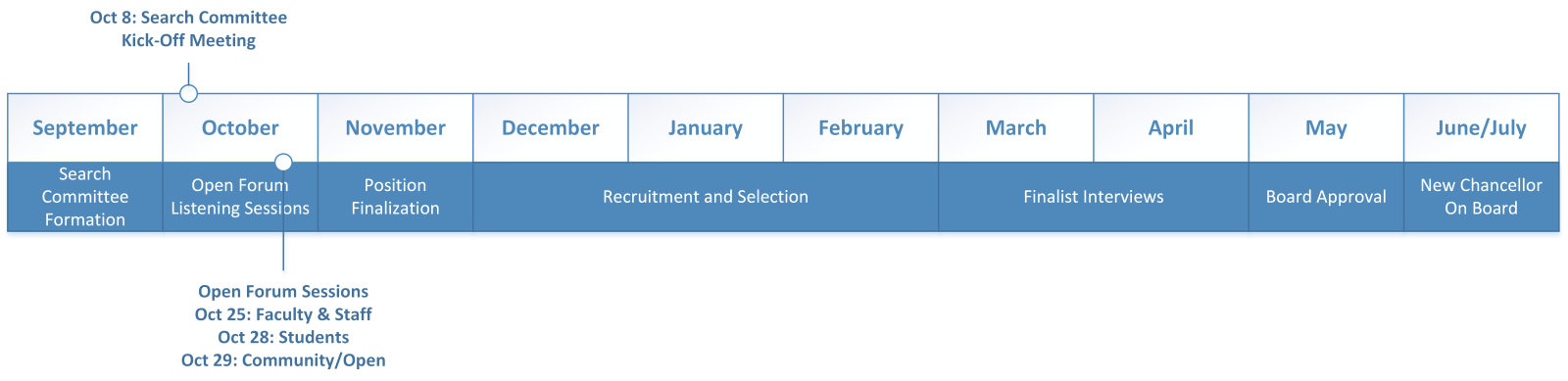
September: search committee formed; October: listening sessions; November: finalize position; December-February: recruitment and selection; March and April: Finalist interviews; May: Board approval; June/July: New chancellor on board

Search Advisory Committee

Beverly Bunch, UIS professor of public administration (Chair)
Atul Agarwal, UIS professor of management, marketing and operations
Bob Blankenberger, UIS associate professor, public administration
Ann Comerford, interim vice chancellor for student affairs at UIS
Johnell Greer, program director in human resources at UIS
Meghan Kessler, UIS assistant professor of teacher education
Jarrod Knapper, UIS student government president
Ryan McCrady, president and CEO of the Springfield Sangamon Growth Alliance
Adrienne Nazon, U of I System vice president of external relations and communications
Ike Oduocha, international student at UIS
Rikeesha Phelon, president, UIS Alumni Association
Peter Shapinsky, UIS associate professor of history
Anne Strahle, UIS associate professor of communication
Allison Thornley, UIS assistant athletic director, strategic planning and finance
M. Lucia Vazquez, UIS associate vice chancellor for research innovation design
Celest Weuve, chair of the UIS Campus Senate and UIS associate professor of Allied Health

Search Firm

Parker Executive Search
Five Concourse Parkway
Suite 2875
Atlanta, GA 30328
Phone: (770) 804-1996
Fax: (770) 804-1917

Campus Community Feedback

The Search Advisory Committee thanks our campus communities for their input, nominations, comments and suggestions. 


University of Illinois - Cookie Information

About Cookies

Cookies and related technologies (herein “Cookies”) are small text files that a website saves on your computer when you visit the site. Cookies the University sets are called first-party Cookies. The data collected might be about you, your device, your preferences, or your login information. This data is mostly used to make the website work as expected so, for example, you don’t have to keep re-entering your credentials whenever you come back to the site. Cookies set by third parties are called third-party Cookies. We use third-party Cookies for analyzing website traffic and our advertising and marketing efforts. We have divided the Cookies we use into the following categories: Strictly Necessary, Performance, Functional, and Targeting. Under each category heading below you will find a general description of the Cookies in each category. You can change your browser settings to block, delete, or alert you to Cookies. The Help menu on the menu bar of most browsers will tell you how to do that. However, if you do, you may have to manually adjust preferences every time you visit a site and some features may not work as intended.

See the University of Illinois System Cookie Policy Link opens in a new window for more information.

Strictly Necessary Cookies - Always Active

Strictly Necessary Cookies are first-party Cookies that are necessary for the website to function. They can be either permanent or temporary and are usually only set in response to actions made directly by you that amount to a request for services, such as logging in or filling in forms. For example, we use Strictly Necessary Cookies to handle user registration and login. Some sites require the use of Strictly Necessary Cookies to access the site, such as University websites requiring University credentialed authentication. If you set your browser to block or delete Cookies, you may not be able to access the site or some parts of the site will not work.

Performance Cookies - Always Active

Performance Cookies allow us to count visits and traffic sources so we can measure and improve the performance and effectiveness of University websites. Performance Cookies also help the University understand which webpages are the most and least popular, see how visitors move around the site, and determine whether webpage content is relevant to user interests. Performance Cookies may be first-party or third party, permanent or temporary, and do not personally identify individual visitors. Some Performance Cookies are “analytics” Cookies (e.g., Google Analytics), using third-party software tools, which help us understand more about how our websites are used and where visitors come from by collecting and aggregating anonymous information on the pages visited and any advertisements viewed. The University does not take responsibility for the collection, use, and management of data by any third-party software tool provider unless required to do so by applicable law. If you set your browser to block or delete Cookies, some site services and functionalities may not work.

Functional Cookies - Always Active

Functional Cookies enhance the performance and functionality of our websites but are non-essential to their use. These permanent Cookies allow our website to remember information from your previous visits, such as details you submitted before or your previously stated preferences. These Cookies may also be used to provide services you request, such as newsletters or publications. They may be first- or third-party Cookies that enable services we have added to our webpages. If you set your browser to block or delete Cookies, some or all of these services may not function properly.

Targeting Cookies - Always Active

Targeting Cookies are used to deliver content tailored to your interests and may be temporary or permanent. They may also be first-party or third-party Cookies. Targeting Cookies are based on uniquely identifying your browser and device; they do not store information such as your name. The University may use targeting Cookies prepared by the University, its third-party contractors, or advertising partners to provide you with personalized University display advertising and promotional material about the University and its programs. The University may also allow third parties to place Cookies on your device that collect and use anonymous information about your visits to, and interactions with, our websites to personalize advertisements and promotional materials for University goods and services. Targeting Cookies may be used by our third-party contractors or our advertising partners to build a profile of your interests and show you relevant advertisements on other sites. We may share information about your use of our site with our social media, advertising, and analytics partners who may combine it with other information that you have provided to them or that they have collected from your use of their services. If you set your browser to block or delete Cookies, you will still see advertisements, but they will be less targeted to your interests.